
In the forest haskell mediacopy3000 Feriel Choutri de Tarlé
Why we use Haskell for MediaCopy 3000
It is quite unorthodox to use the Haskell programming language for a desktop application, but so far the language has proven to be a robust platform to tackle the inherent complexity of graphical user interfaces.
Taming GTK with an Elm architecture
Coming from the C world, GTK 4 is a very imperative UI toolkit. It is also one of the best FOSS toolkits around in terms of accessibility, debugging and providing you with a flurry of utilities to make graphical interfaces that we would usually reinvent in a website.
The GTK developers have poured immense efforts into making GTK 4 and Adwaita an excellent toolkit, but the problem remains: It's still very imperative.
However, The Elm programming language and its famed architecture, itself an adaptation of Moore machines, is very well-suited for bringing some predictability into all of this.
The architecture goes as follow:
- The Model, is a record holding our application state;
- The View expresses the interface in terms of Haskell data structures;
- User interactions send Messages, which trigger an Update function that rebuilds the View (via other messages);
- The Render function that takes your View and turns it into GTK widgets.
This buys us something incredible: We do not litter the codebase with effectful calls to the GTK library to update widgets. Instead, the UI is completely built in terms of Haskell data structures, and the rendering is done at a very specific place.
In practice, this means that we can build the UI in ways that are completely artificial, since we do not need click on the UI to change the views, but simply sending messages to the engine.
This enabled us to make a screenshot-taking utility that builds Scenes and sets those scenes as the default state during application start-up. This is a particularly nifty way of doing so, because if the application is a complete black box, you have to resort to automating user clicks, which is a massive hassle.
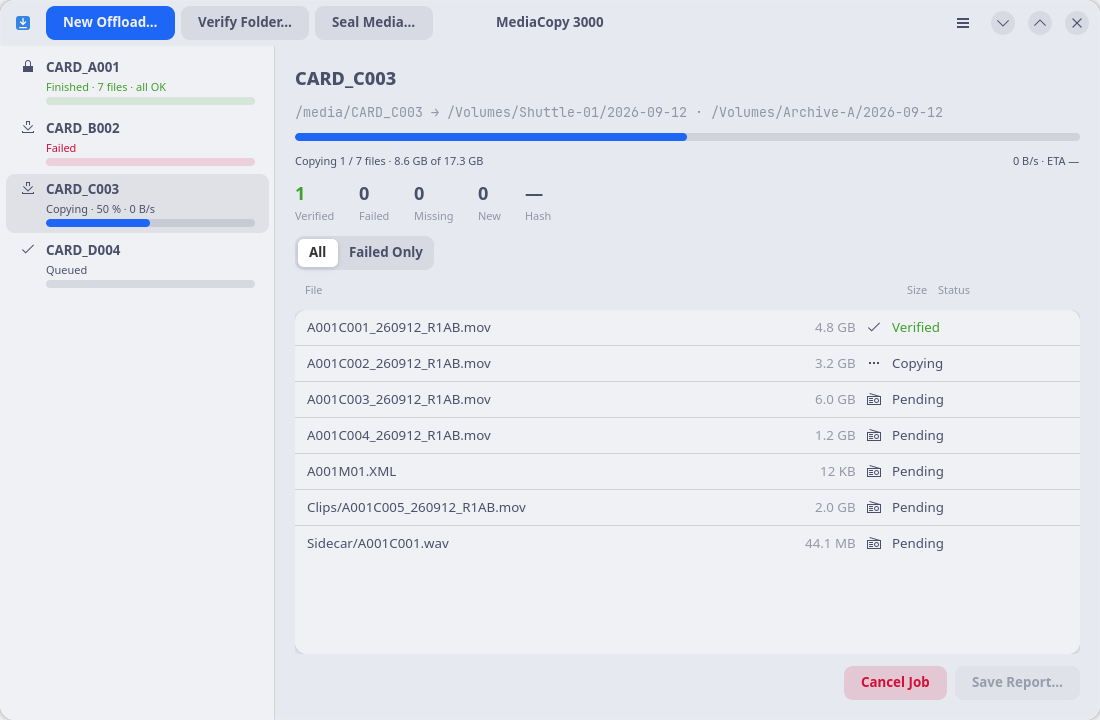
And as a bonus, because so much happens on the Haskell side, we can emulate the filesystem in memory during tests.
Reliable domain modelling with rich and powerful types
Amongst all of the domain modelling that we have done thanks to Haskell types, we'd like to put the spotlight on Job events.
Jobs are the abstract actions of offloading, verifying and sealing a media source. They are composed of many steps, and these steps emit events as they progress. Here is a simplified list of those events:
- A job is Planned, Finished or has Failed;
- The Status of a file has Changed;
- There is Progress with copying data;
- The Manifest is being written and is done being written;
or in Haskell:
data JobEvent
  = Planned PlannedWork
  | FileStatusChanged RelPath FileStatus
  | Progress Int64
  | ManifestWriting
  | MhlWritten OsPath
  | JobFinished JobResult
  | JobFailed Text

data FileStatus
  = Pending
  | Hashing
  | Copying
  | Flushing
  | Publishing
  | Verifying
  | Done FileOutcome

data FileOutcome
  = Ok
  | HashMismatch Mismatch
  | Missing
  | New
  | IoError Text
  | Replaced Mismatch
  -- […]
As you can see, the types are separated in a way that there are no possible confusion between success and failure states.
Not only we emit events when data is being moved around, but we have an exhaustive enough view of the times where the application is waiting on the operating system to synchronise the file system and the memory.
Since it's hard to tell what's going on when the external drive doesn't have a blinking LED, we have to tell the end-user that something is happening. Otherwise they might believe that the application has frozen and would kill it.
In Conclusion
An unorthodox choice, but so far Haskell is a perfectly fine language to interface with GTK. The documentation on the Haskell side is a bit lacking, but we expect to write about our applications' internals enough to help others do it too. Thank you Haskell!